S Sandustry Tips
Beginner mistakes

Most early factory problems come from hidden flow

Direct answer: beginners usually fail by scaling too early, mixing inputs and outputs, hiding Water loss, trapping Gold under clutter, or letting byproducts block fresh material.

Rule of thumb

If you cannot trace a material path, do not expand it

Make the factory easier to read first. Throughput comes after diagnosis.
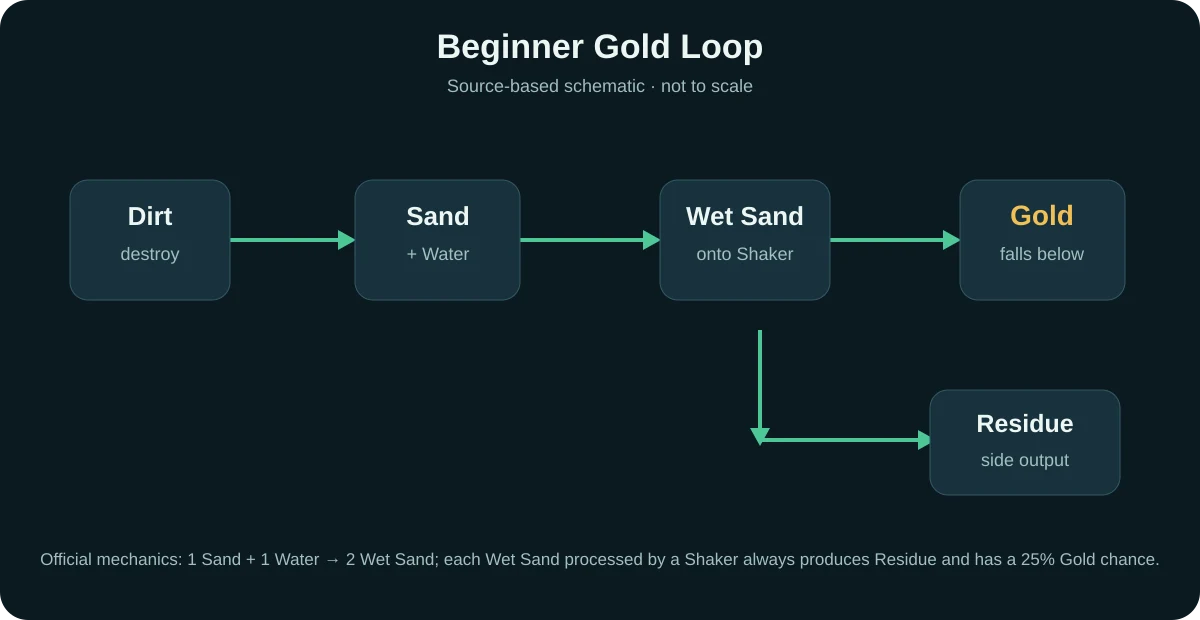
Sandustry beginner loop diagram showing Sand, Water, Wet Sand, Shaker, Gold and Residue paths
Most early mistakes hide one of these paths. Keep input, useful output and byproduct exit visible before scaling.

Seven mistakes to fix early

1. Building a large layout before one small line worksFix it by proving a single Wet Sand to Shaker to Gold path first.
2. Mixing fresh input with byproduct outputGive Residue and other unwanted output a separate exit so it cannot bury the useful feed.
3. Treating Water as decorationWater behavior affects Wet Sand production, so keep it visible and controlled near the mixing area.
4. Blocking the Gold collection areaLeave clean space where Gold should pass or settle, instead of filling every tile with transport.
5. Adding Filters without checking what they are solvingUse a Filter where a specific unwanted material needs to be separated, not as a universal repair.
6. Rebuilding before observing the symptomWatch whether the failure starts at input, processing, output, Water or transport.
7. Copying a blueprint as if terrain does not matterUse blueprint pages as flow diagrams; adapt spacing and routing to the actual map.

Quick checks before expansion

Can you point to the input source?
Can you point to the useful output?
Can you point to the waste/byproduct exit?
Can you see where Water enters and disappears?
Can you isolate one machine that is slowing the line?
Can you remove one part without breaking the whole factory?

Upgrade path

Avoiding these mistakes is the baseline. The upgrade point comes when a proven small loop needs to grow, and the rule changes from fixing what breaks to repeating what works.

  • Once one Wet Sand to Shaker to Gold path runs steadily, copy that proven chain instead of building a large layout in one pass.
  • If the same byproduct keeps blocking the line, redesign its exit rather than clearing it again.
  • When new machines such as Filters, Pipes or Launchers unlock, decide whether each one solves a real separation problem before adding it.
  • If a blueprint keeps failing on your map, treat it as a flow diagram and adapt spacing and routing to the terrain.
  • When you are about to rebuild without seeing the symptom, run the symptom-first checks first.

What to read next

Water is confusing

Understand Water as a system, not a single tile.

Water Mechanics

Core mistake pattern

The earliest factory failures usually come from a small set of repeated planning mistakes that stay visible if you keep one readable loop instead of scaling confusion.

What still depends on your playstyle

There is no single correct style for every run. Avoiding these seven mistakes gives you a cleaner base, but terrain and personal priorities still decide how the factory develops.

Featured Questions

What are the most common beginner mistakes in Sandustry?

Building too large too early, mixing byproduct with input, hiding Water behavior, blocking Gold output, and rebuilding before identifying the first visible symptom.

Why do beginner factories become unreadable so fast?

Because several material paths start sharing the same space before one stable loop has been proven, so every failure looks like everything broke at once.

Should I copy a blueprint exactly when I am new?

No. Use blueprints as flow diagrams, then adapt spacing and routing to your terrain instead of assuming the map will behave identically.

Primary Sources

Source note: This recommendation is source-based, not an independently benchmarked build.

Official source