Learn one stable loop first
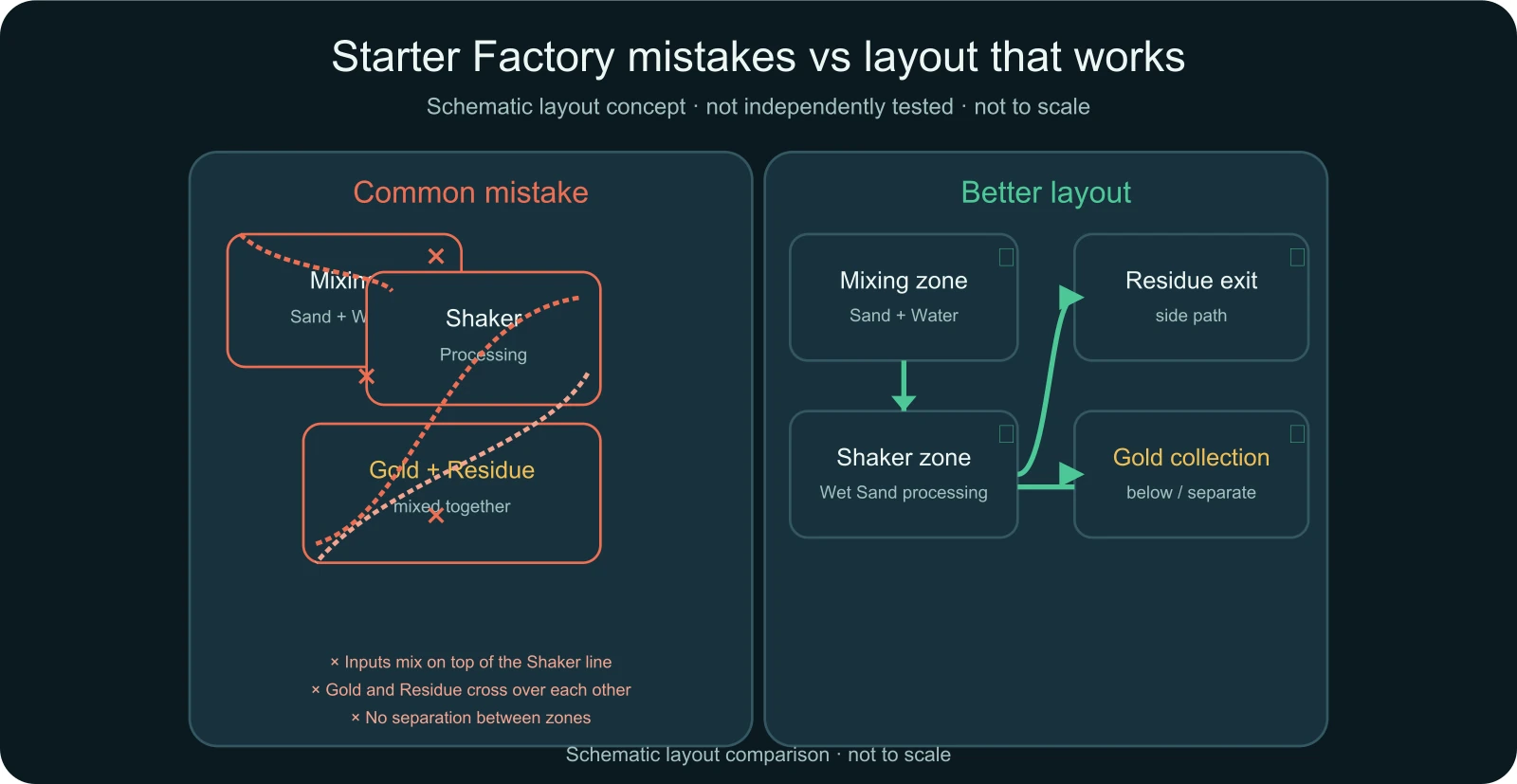
Do not judge the opening setup by maximum throughput. First make sure you can see where Wet Sand enters, where Gold falls, and where Residue exits.
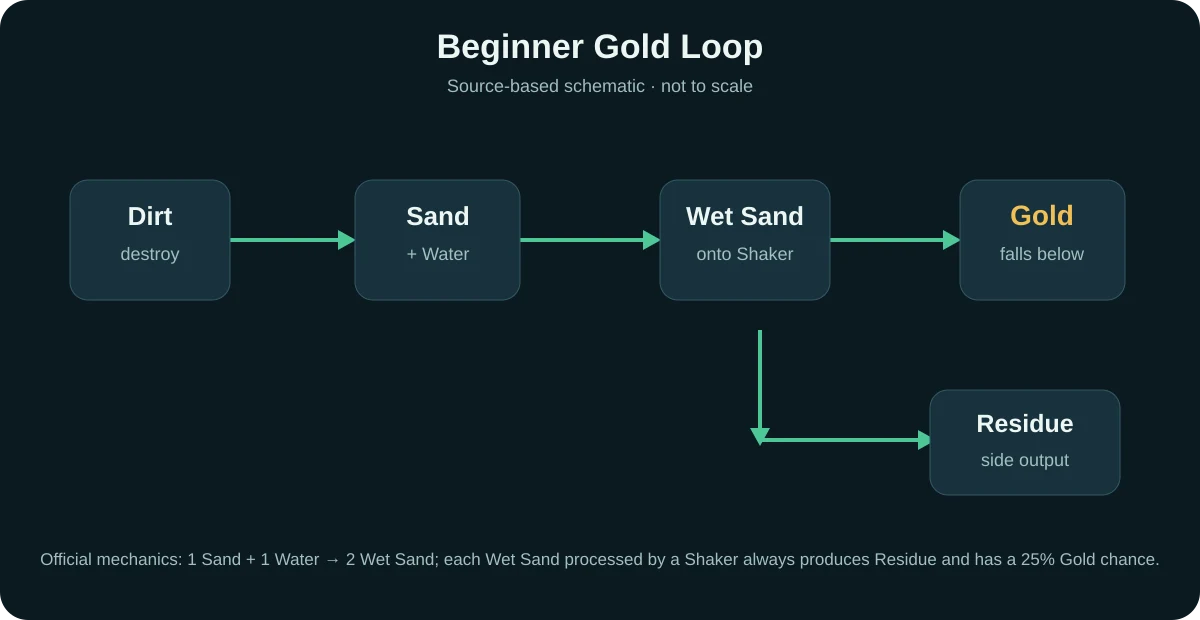
Quick answer: destroy Dirt to get Sand, mix Sand with Water to make Wet Sand, then feed Wet Sand onto a Shaker. A Shaker always turns each Wet Sand pixel into Residue and has a 25% chance to also drop one Gold through the bottom.
Do not judge the opening setup by maximum throughput. First make sure you can see where Wet Sand enters, where Gold falls, and where Residue exits.
The trailer shows the game in motion. Open it on YouTube if you want a quick feel for terrain shaping, material flow and early factory rhythm before following the five steps.
Open on YouTubeThe official wiki lists Sand as a material dropped from destroying Dirt. Let the Sand collect somewhere you can control instead of scattering it across the terrain.
Checkpoint: you have a reachable pile of Sand.
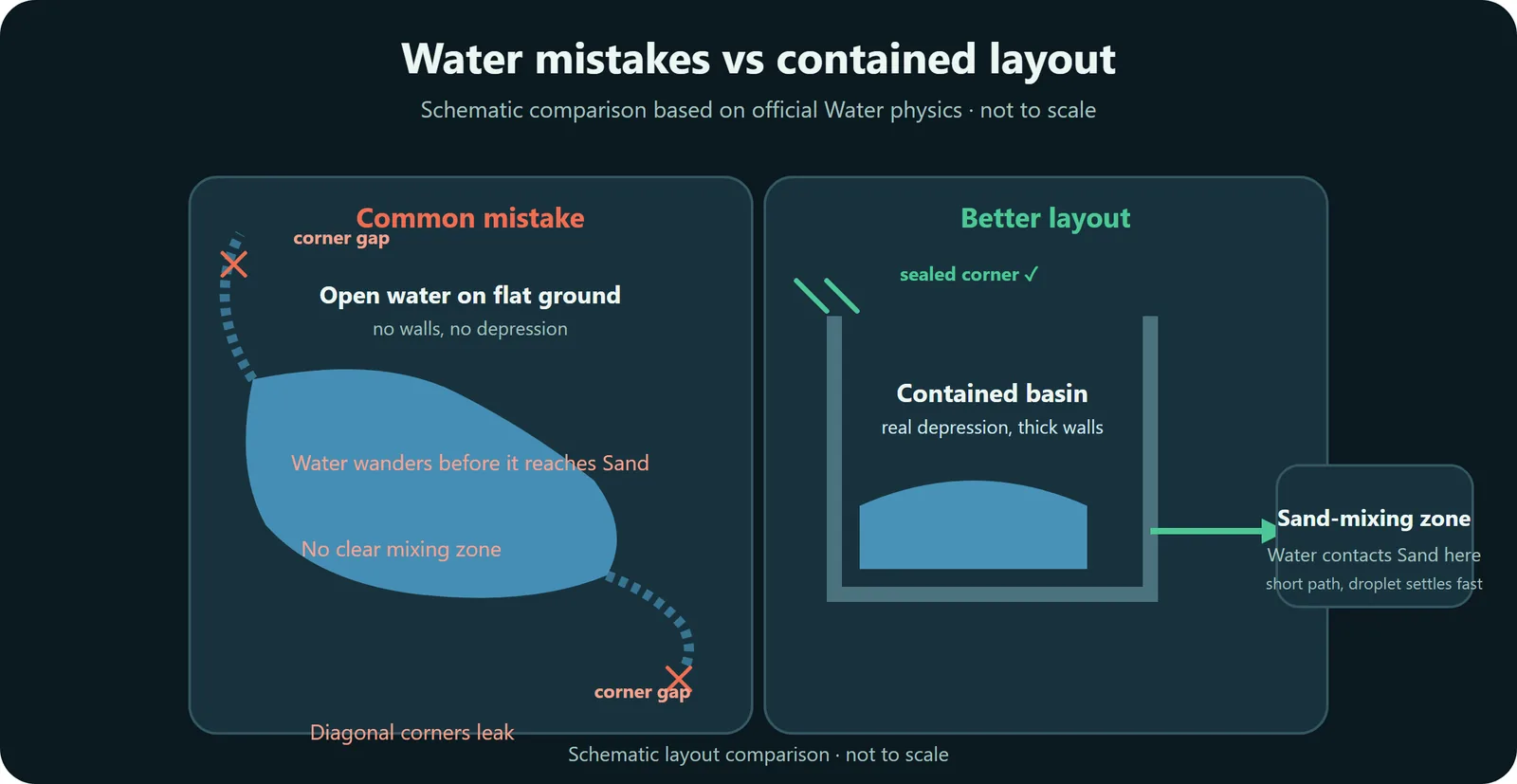
When one Sand pixel touches one Water pixel, both are replaced by two Wet Sand pixels. Keep the mixing area contained so Water does not wander away before it reaches the Sand.
Checkpoint: the material changes into Wet Sand where the two meet.
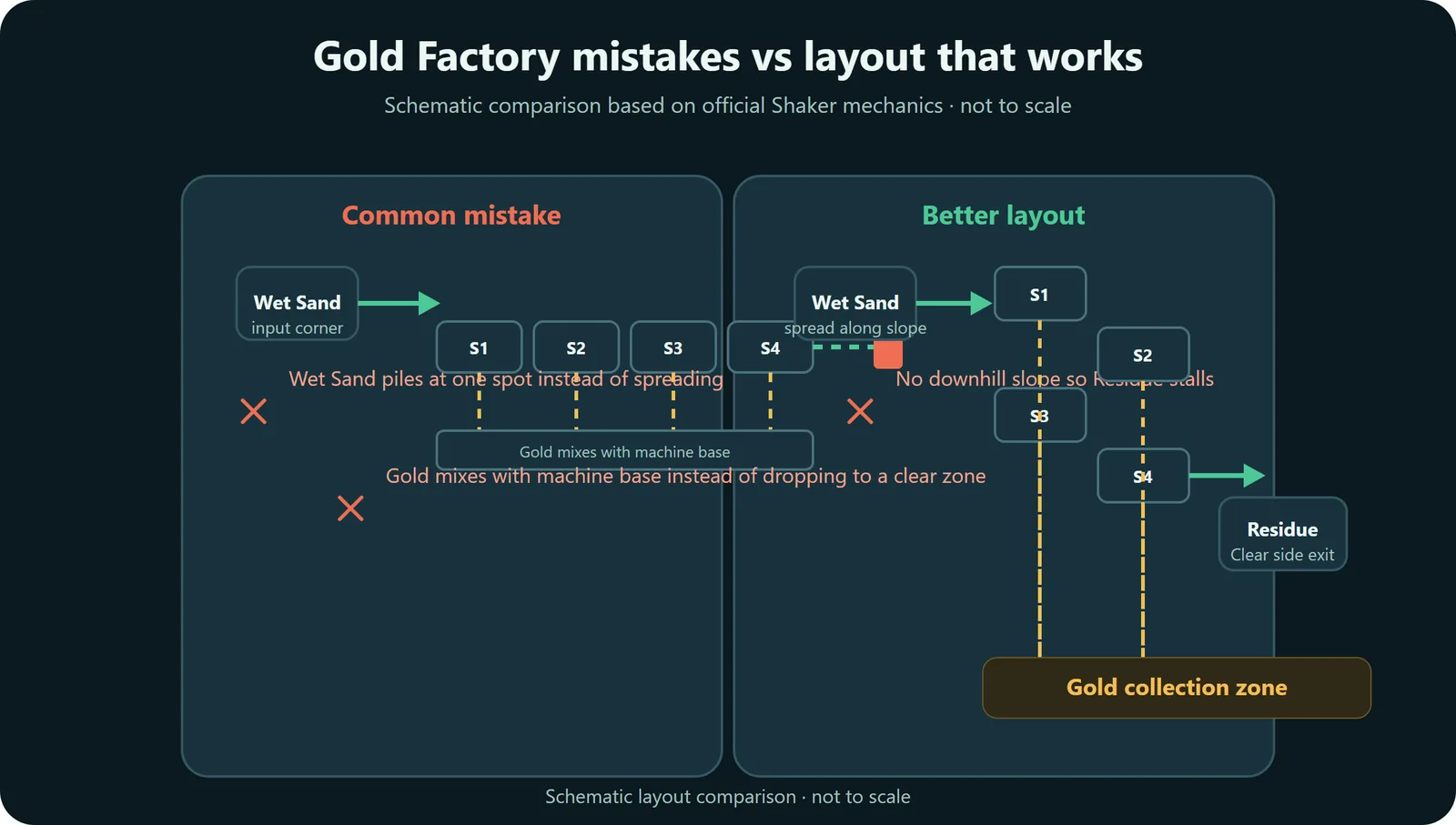
The official Shaker page recommends a downward diagonal arrangement because Shakers move Residue slowly. Wet Sand is denser than Residue, so a staircase helps fresh input settle while Residue moves toward an exit.
Checkpoint: each Shaker sits slightly lower than the previous one.
Each Wet Sand pixel always becomes Residue, with a 1-in-4 chance to also produce one Gold. Gold is the only solid that passes through a Shaker, so leave collection space below the machines.
Checkpoint: Gold falls below while Residue remains on top and moves toward the side.
Residue is not just trash: it can be burned into Burnt Residue and used later. Even before you automate that chain, give Residue a clear place to leave the Shakers so it does not bury the input.
Checkpoint: Residue can leave the processing area without blocking new Wet Sand.
Water flows downhill, can slip through diagonal corners, and a droplet that fails to settle in a depression within 45 seconds can evaporate into the rain buffer.
Read the Water mechanic →Gold output at the Shaker is probabilistic. A short sample can produce a dry spell; first verify that the input is actually Wet Sand and that the Shaker is processing.
Check the Shaker rules →Shakers push Residue slowly. A descending staircase and a clear side exit reduce backup compared with a flat, blocked arrangement.
See the Gold layout concept →Gold is the only solid that passes through the body. Other solids can become trapped and may need manual removal.
Factory troubleshooting →The five-step loop is a starter proof of concept, and it is designed to be outgrown. When the loop can run a full cycle without you stepping in, that is a good point to turn it into a factory you can leave running.
Your first Gold result comes from a short sequence built around Sand, Water, Wet Sand, a Shaker, and visible byproduct handling.
The fastest opening, short-run output, and exact recovery steps still depend on terrain and execution. Use these five steps to build a readable start, then adjust around the first problem you actually see.
Make Wet Sand by bringing Sand and Water together, feed it into a readable Shaker line, keep space below for Gold, and keep Residue from covering the input.
Because Water may leak or evaporate, Wet Sand may not reach the Shaker cleanly, or Residue may bury the line before the loop is stabilized.
Turn it into a first factory with clearer separation and more readable failure points instead of just stacking on more machines.
Source note: This recommendation is source-based, not an independently benchmarked build.
Official source