Lava quick facts
- Spawns naturally in underground Lava Caves
- Snow freezes it into Scoria, which drops Cinder
- Cinder is transportable and re-burns into Lava
- Trapped in a Filter, it ignites what passes over
Lava is both a hazard and a tool. It appears naturally underground, can be redirected where you want it, and can be frozen, transported, and re-ignited to power the heat side of your factory.
v0.5.6 update: Lava now destroys Fluxite, Redsoil, and Strataform terrain. Cold Thermal Buffers also return Lava to Cinder instead of always consuming it.
Your first Lava is not built; it is found. Knowing where it lives changes how you plan both exploration and later heat routing.
Lava occurs naturally in the underground Lava Caves, so the question early on is less "how to make it" and more "how to reach it and stay safe."
Lava is not stuck where it spawns. It can be guided, which matters when you want the heat near a machine instead of deep in a cave.
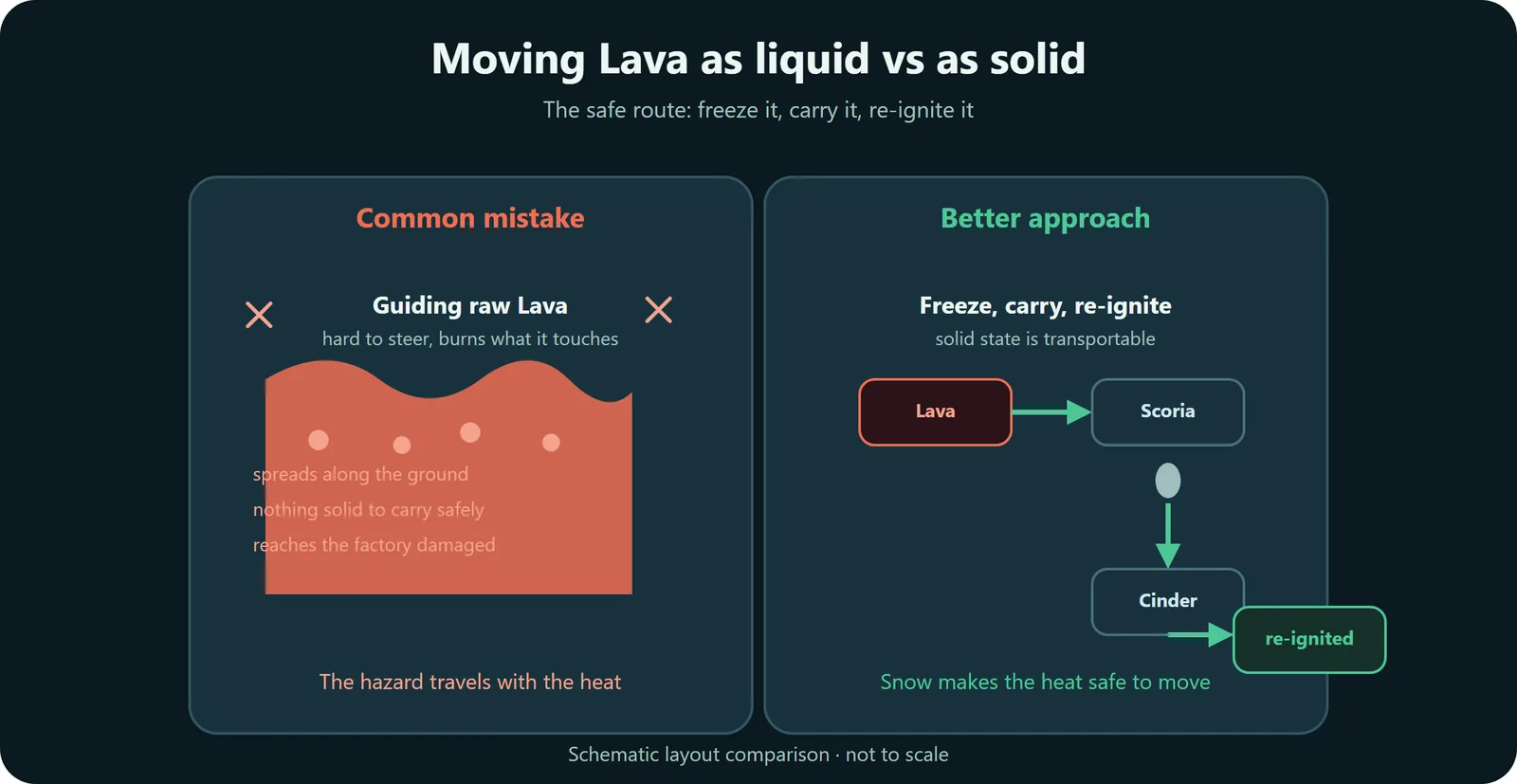
The cleanest way to relocate Lava is not to move the Lava at all. Freeze it, carry the solid, then restore the heat at the destination.
Snow meeting Lava hardens it into Scoria. That single state change turns a hazard into a solid you can handle.
Destroy the Scoria to collect Cinder, the form of Lava that can be transported without burning you on the way.
Apply a Flamethrower to the Cinder and it turns back into Lava, closing the loop at the point where you want the fire back.
Once Lava is available through a controlled setup, it stops being only a threat and becomes an input for burning and heating.
Lava trapped in a Filter ignites pixels that pass over it, which lets you burn Residue or Flower automatically as they ride across. See the Filter page for the setup.
Lava in direct contact with a Thermal Buffer transfers a large amount of heat, but the exact result now depends on buffer state. In v0.5.6, a cold Thermal Buffer adds less heat and turns Lava back into Cinder instead of always consuming it outright.
Update #3 changed several real planning rules around Lava. Open Lava now destroys Fluxite, Redsoil, and Strataform terrain, so route protection matters more around those materials than it did in earlier builds.
The Thermal Buffer interaction is also more conditional. When the buffer is below zero temperature, Lava adds less heat and converts back into Cinder. In artifact rooms, Thermal Buffers no longer consume Lava at all. Use the v0.5.6 patch notes if you are comparing an old setup with current behavior.
Eventually you may rely less on cave hunting. The late game can add a repeatable Lava source.
A late-game tool can generate Lava indefinitely, removing the need to transport it from a cave at all. Its exact unlock cost is not yet pinned down in Early Access.
Pipes never move Lava, so the freeze-and-carry route through Cinder is the practical relocation method described here before the Volcanizer arrives.
Lava is the game's movable heat source. You can redirect it, freeze it into Scoria with Snow, carry that heat as Cinder, and later restore it to Lava. That freeze-carry- reignite chain is the practical way to relocate heat before late-game generation.
The safest cave route, best burner footprint, and final heat infrastructure still depend on terrain, hazards, and how far you need to move the heat source. exact moment when a Volcanizer should replace cave hauling. Those are build-specific choices layered on top of the core mechanic.
The documented practical route is to freeze Lava into Scoria, destroy it into Cinder, move the Cinder, and re-ignite it at the destination.
No. Pipes are a non-Lava fluid system, which is why the Cinder loop matters so much for relocating heat.
Controlled Lava can drive burning setups such as the Filter auto-burner and can also feed dedicated heat structures like the Thermal Buffer.
Lava can be redirected, frozen and re-ignited, so a layout can treat it as a heat source instead of only a hazard.